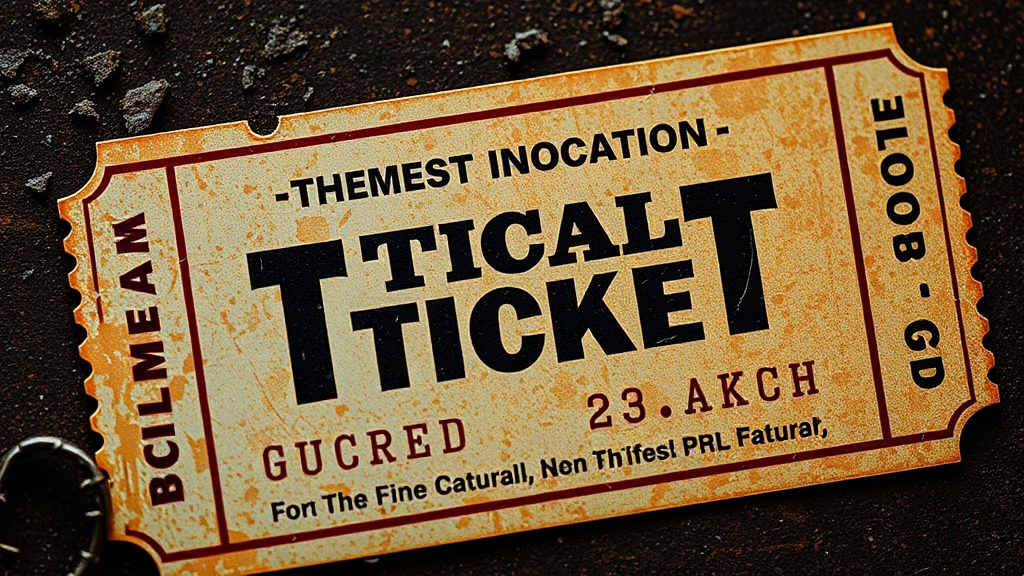
Cracks, Creases, and Color: A Practical Guide to Vintage Ticket Condition

Many collectors, especially those new to the hobby, fall into the trap of believing that any old cinema ticket holds significant value just by virtue of its age. It’s a common misconception, fed by romantic notions of history and nostalgia. But the truth is, the age of a ticket tells only part of its story. The real narrative—and often, the bulk of its monetary and aesthetic worth—lies squarely in its condition. Ignoring condition when acquiring or assessing your collection can lead to disappointment, diminished display potential, and a poorer long-term investment. This guide isn't about general authentication or broad valuation; instead, we'll dive deep into the tangible aspects of a ticket’s physical state, arming you with the practical knowledge to meticulously evaluate vintage cinema tickets, ensuring you understand exactly what you're bringing into your cherished collection.
Why does condition really matter for my cinema ticket collection?
Understanding the true impact of a ticket’s condition goes beyond just its market price. It’s about the tangible experience of collecting, the preservation of history, and the potential for appreciation. A pristine ticket, even from a common film, almost always outshines a heavily damaged one, regardless of its rarity. There's the undeniable visual appeal; a clean, crisp ticket presents the art and design of its era as intended, offering a clearer, unblemished window into the past. Imagine a beautifully designed ticket from a classic Hollywood premiere—now picture it water-stained and torn. The magic diminishes, doesn't it? This aesthetic degradation affects personal enjoyment and how others perceive your collection.
Then, think about long-term preservation. Tickets, typically fragile paper or cardstock, are susceptible to environmental factors like humidity, light, and acidity, which can cause them to degrade over time. A ticket already compromised by tears or severe creases is far more vulnerable to further damage, even with careful handling and archival storage. Minor flaws have a nasty habit of worsening; what might seem like a small imperfection today could become a significant point of structural failure or widespread discoloration tomorrow. By prioritizing tickets in better shape, you’re setting your collection up for lasting endurance, ensuring these slivers of cinematic history can be enjoyed by future generations. Investing in a ticket with fewer pre-existing issues minimizes the risk of accelerated decay.
Finally, market dynamics are impossible to ignore. While many of us collect primarily for personal enjoyment, the reality is that condition directly correlates with market value. Should you ever decide to part with a piece of your collection, or even just assess its insured value, the grading it receives will be the primary determinant of its worth. A ticket graded as "Very Fine" will command a significantly higher price—sometimes many multiples—than one deemed "Good" or "Poor," even if both are otherwise identical in rarity and historical significance. It’s a clear case of quality trumping mere existence, and savvy collectors understand this interplay between preservation and financial appreciation.
What specific flaws should I look for when examining vintage tickets?
With a magnifying glass and good light, you can begin to identify the common culprits that diminish a vintage ticket’s condition. This isn't about finding perfection—that’s rare—but understanding the spectrum of imperfection and how each type impacts the overall assessment. Develop a systematic approach; inspect each ticket from top to bottom, front to back, noting every detail.
Creases and Folds: These are perhaps the most ubiquitous forms of damage, often resulting from a ticket being folded into a wallet or pocket. There's a spectrum here. A soft bend, an almost invisible undulation in the paper, is one thing; a hard, permanent crease that visibly breaks the paper fibers and leaves a distinct white line is another entirely. Look for lines where the paper has been bent. Are they faint, barely visible impressions that might flatten out with proper storage, or deep, sharp folds that extend completely across the ticket, permanently altering its structure? Multiple folds, particularly those that crisscross or distort the ticket’s printed information—like a film title or date—are far more detrimental. Serious creasing can even lead to micro-tears along the fold line.
Tears and Missing Pieces: Any tear, no matter how small, fundamentally compromises the ticket’s structural integrity. Even tiny nicks along the edges, often caused by rough handling, can detract significantly. Missing pieces are, of course, a major issue. A complete ticket, even with other minor flaws, is generally more desirable and holds greater value than one with a section gone, especially if that portion contains critical information such as the film title, date, location, or price. A ticket with a large chunk missing is inherently incomplete and aesthetically unappealing, relegating it to a lower tier of desirability.
Stains and Discoloration: These blemishes can come in many forms and are often tell-tale signs of a ticket’s history and its environment. Look closely. Water rings, oil spots (from fingers, food, etc.), foxing (the age-related brown spots caused by mold or metallic impurities in the paper), or general uniform yellowing from prolonged light exposure are common. Is the discoloration uniform across the ticket, suggesting natural aging, or localized, pointing to an accidental spill, moisture damage, or direct environmental exposure? Ink stains, especially if they obscure text or images, are particularly problematic. Remember, some natural patina and slight toning are expected with age—it’s part of a vintage item's charm—but heavy, dark, or extensive staining indicates poor preservation conditions and can significantly reduce a ticket’s appeal and value.
Perforations: These little cuts, precisely designed to allow easy tearing for admission, are surprisingly important indicators of a ticket’s past. Examine them closely. Are they clean and intact, showing a crisp separation, or are they frayed, missing sections, or torn haphazardly? A ticket cleanly separated along its perforations is generally preferable to one with ragged, uneven edges where the original perforations once were. Worse still are instances where the perforations have been completely ripped away from the main ticket body, creating an untidy, irregular border. Also, check for any repairs in this area—often, clear adhesive tape was used in the past, which degrades over time, yellows, and can cause further, irreversible damage to the paper fibers it adheres to.
Edge Wear: The edges and corners of a cinema ticket are typically the first points of physical contact and, thus, often the first to show signs of wear and tear. Are the corners relatively sharp and defined, or are they noticeably rounded, softened, or even dog-eared from repeated handling? Are the edges smooth and straight, or are they frayed, chipped, or showing visible rubbing? Minor, subtle wear along the perimeter is normal for an item of its age, but excessive fraying, multiple nicks, or pronounced rounding of all four corners strongly suggests a ticket that’s seen a lot of movement, rough handling, or inadequate storage over its lifetime. These seemingly small details contribute significantly to the overall perceived quality.
Writing and Stamps: While occasionally charming—perhaps a period usher’s initial or a unique promotional stamp—any non-original marks on a ticket are generally considered damage that detracts from its condition. This includes pen marks, pencil notes, or even rubber stamps that weren't part of the original issuance (like a previous owner's personal collection stamp added much later). The key is "non-original." An authentic usher's mark from the showing might add historical character, but a random doodle does not. Unoriginal writing that defaces key information, like the film title, date, or seat number, is always a significant negative. If you're unsure if a mark is original, research other examples of the same ticket; consistency across multiple examples can be a clue to originality.
Fading: Exposure to light, especially direct sunlight or harsh artificial lighting, is one of paper’s worst enemies, causing colors to fade and paper to become brittle over time. Compare the vibrancy of the colors on your ticket to what you might expect for a piece from that era, or to images of the same ticket in better condition if available. Fading can make a ticket look washed out, dull, and significantly less appealing, diminishing its visual impact. It’s often an irreversible form of damage and indicates that the ticket wasn't stored away from harmful UV rays, making it a red flag for overall long-term preservation. A faded ticket speaks volumes about its past life and the care it (or didn't) receive.
How can I objectively grade my cinema tickets at home?
While there isn't a universally adopted, formalized grading scale for cinema tickets like there is for comic books or coins, applying a consistent, objective approach to your assessments will help you understand your collection better and communicate its quality more accurately. Think of this as a working framework for personal use, when discussing tickets with fellow collectors, or when making purchasing decisions. Precision in grading is a skill that develops with practice and a keen eye.
Start your evaluation process with a methodical setup. Ensure you have a clean, flat, well-lit workspace. Natural daylight is often best, but a good quality, neutral-toned LED lamp can also work wonders. Always use a soft, lint-free cloth or cotton gloves to handle tickets, avoiding direct skin contact with the surface—finger oils can leave irreversible marks over time. A jeweler’s loupe or a simple magnifying glass (10x magnification is usually sufficient) can reveal intricate details and subtle flaws invisible to the naked eye, allowing for a truly granular inspection.
Consider these broad categories for grading, keeping in mind that achieving a "Mint" grade for genuinely vintage tickets is exceptionally rare:
- Mint (M): Exceptionally rare for vintage tickets. A ticket that appears as if it just came off the printer. No flaws whatsoever—no creases, no tears, no discoloration, perfectly sharp edges and corners, immaculate perforations. Unlikely to be found outside of archival, climate-controlled storage from day one.
- Near Mint (NM): Almost perfect, but with the slightest, nearly imperceptible imperfection upon very close inspection—perhaps a microscopic softening of a single corner, or the faintest hint of uniform age-toning that absolutely does not detract from its overall appeal. The image and text remain exceptionally crisp, colors are vibrant and true to original, and perforations are complete and sharp. This is an aspirational grade for many serious collectors.
- Very Fine (VF): An undeniably attractive ticket with only minor, isolated flaws. It could have one or two very light, non-breaking creases, minimal and even edge wear, or slight, uniform age-toning. All essential information—titles, dates, pricing—is perfectly clear and legible, colors are strong, and the overall structural integrity of the ticket is excellent. This is often the most realistic target grade for serious collectors, offering a superb balance of condition and availability.
- Fine (F): A solid, collectible ticket that clearly shows signs of gentle handling and age, but remains complete and aesthetically pleasing. You might expect to find several minor, perhaps more visible, creases that don't break the paper, some noticeable but not severe edge wear, perhaps a small, shallow tear (crucially, not extending into the main body of the ticket), or a slightly more pronounced but still uniform discoloration/staining. The image and text are still quite clear, though perhaps not as crisp as a VF ticket. Despite its flaws, a Fine ticket still holds significant appeal.
- Good (G): This is a serviceable ticket that has definitely seen better days, yet still holds its historical significance. It will exhibit significant wear, such as multiple folds, prominent creases that may show slight paper breaks, several small tears or perhaps one moderate tear (though ideally not across central imagery), more pronounced edge fraying, or significant, perhaps uneven, discoloration/staining. Crucial information might be slightly obscured but still discernible, and the ticket is still recognizable and structurally mostly intact. While less aesthetically pleasing, a Good grade ticket can still be a welcome addition for its historical value, especially if it's a rare item. Its market value, however, drops considerably at this point.
- Poor (P): A heavily damaged ticket. This grade implies major flaws—large, obtrusive tears, significant missing pieces that impact integrity, heavy staining that obscures large portions of the ticket, severe creasing that has clearly broken paper fibers, or very faded print making key details difficult to discern. While still historically interesting, its aesthetic appeal and market value are minimal. This is typically a ticket you’d acquire only if it represents an incredibly rare item for which no better example exists, or if your primary interest is simply having a placeholder piece of history regardless of condition.
The key to successful grading is consistency and objectivity. When you’re evaluating a ticket, compare it against your internal benchmarks for each grade, and resist the urge to grade up due to sentimental attachment or excitement over a new acquisition. A careful, honest assessment will not only help you build a truly remarkable collection but also foster a more informed and transparent collecting community.
For those interested in the broader principles of paper preservation that underpin these assessment criteria, the